
Listening to Farmers? Whats the worst that could happen?
There is a big difference between having an idea that could work on a farm and developing something that a farmer can actually use.
That was one of the biggest takeaways from my recent residency at the Royal Agricultural University (RAU), a programme designed to help us work more effectively with farmers.
For me, this came at a particularly interesting point in Terravore’s journey. I have spent a lot of time thinking about food waste, vermicomposting, soil health and how we can create more circular systems between the places that produce food, the businesses that serve it and the land that ultimately supports it.
But if you want farmers to be part of that system, you cannot design everything from the outside and then arrive with a finished solution.
You have to understand the farm first.
And over the course of the residency, I was reminded just how innovative modern farming already is.
First stop: Stowell Farms

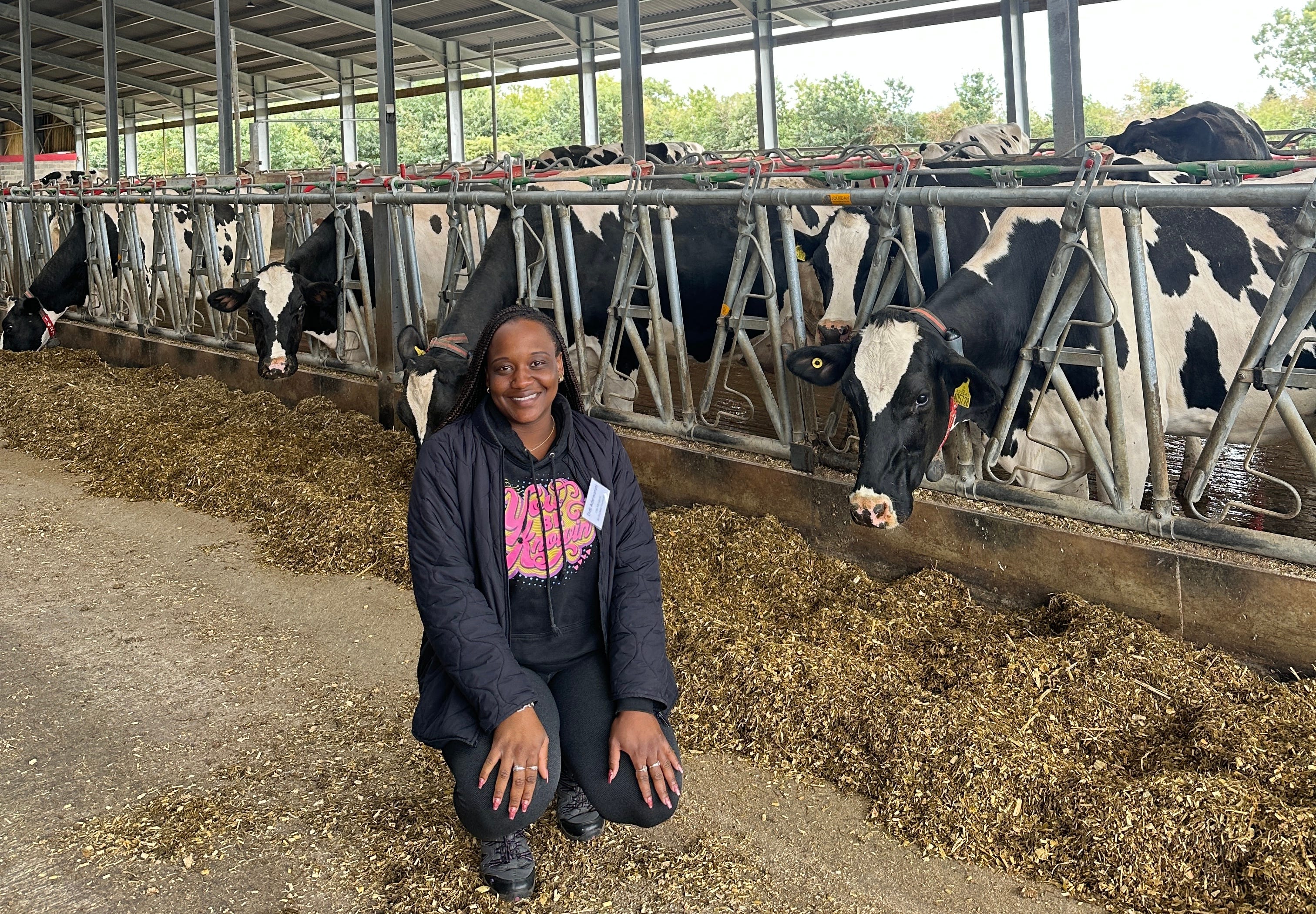
One of our visits took us to Stowell Farms, a dairy operation with more than 900 cows.
When people hear the word innovation, agriculture probably isn’t always the first industry that comes to mind. Walking around Stowell quickly challenges that perception.
The farm uses a highly automated approach to caring for and managing its herd, with 16 robots supporting its dairy operation.
These robots perform different jobs across the farm. Some help feed the cows, some pack and manage the cow manure, and others milk the cows.

Robot preparing a cow to be milked.
What interested me wasn’t simply that robots were being used. It was how different technologies had been incorporated into the day-to-day running of a working farm.
With a herd of more than 900 cows, an enormous amount happens at any one time. Automation can help farmers manage repetitive processes while also generating information that supports decisions about individual animals and the wider herd.
Technology and animal welfare
One thing that really stood out to me during the visit was the attention given to animal welfare. It would be easy to look at a highly automated dairy farm and assume that the technology is primarily about producing more milk or reducing labour. But seeing the farm in person showed me a different perspective.
The technology also helps farmers monitor and care for such a large herd. The robotic systems let the cows interact with parts of the dairy system in a way that fits into their daily routines, while the information generated helps the team track individual animals and identify where attention may be needed.

This was particularly interesting because Sharcott Pennings Farm is one of only two UK dairy farms involved in a partnership with Aldi, Arla Foods and LEAF (Linking Environment and Farming) aimed at giving the British public greater insight into modern farming.
For me, that matters. There is often a gap between how we imagine food is produced and what actually happens on a working farm. Visiting the farm let us see the systems for ourselves, ask questions, and understand that conversations about productivity, technology, sustainability, and animal welfare don't necessarily have to happen separately. On a modern farm, they increasingly intersect.
Nothing goes to waste
Another part of the farm that caught my attention was what happens to the cows’ manure. Rather than seeing it simply as a waste product, the farm uses anaerobic digestion (AD) to turn it into a resource. Powering more than 33,000 homes in the area with its waste. Fed into the National Grid.
The manure is fed into the AD system, where organic material is broken down to produce biogas, which is used to generate electricity. I loved seeing this in practice because it is a great example of circular thinking on a working farm: something that could be treated as waste becomes part of the farm’s energy system.
It also brought the conversation back to what we are trying to achieve with Terravore. Whether cow manure goes into an anaerobic digester or food waste is transformed through composting and vermicomposting, the principle is similar: waste doesn’t always have to be the end of the story. Sometimes it can be the beginning of another one.

And, importantly, this isn’t technology existing in isolation. This is part of a commercial farming system producing milk that ultimately enters major supply chains, including Aldi and Arla.
Standing there, I found myself thinking about something we often get wrong when talking about agricultural innovation. We sometimes talk about farming as though we need to introduce technology to agriculture. Yet farmers already adopt sophisticated technologies that solve real problems.
Perhaps the more useful question for innovators is:
Does what we’re developing solve a problem that farmers actually have?
A robot that moves cow manure towards the anaerobic digestion plant.
Second stop: Sapperton Wilder
Some cows who don’t need a fence
Our next visit offered a very different picture of agricultural innovation.
At Sapperton Wilder, cattle graze without the physical fencing I would normally expect to see around them.
Instead, the cattle wear collars that form part of a virtual fencing system.

The collars help establish boundaries for where the animals can graze. As an animal approaches its designated boundary, the system alerts it, allowing managers to control grazing areas without relying entirely on conventional physical fencing.
Watching cattle grazing freely while knowing that an invisible digital boundary was helping determine where they could go was fascinating. It also reminded me that agricultural technology doesn’t always have to look like a giant piece of machinery.
Sometimes innovation is almost invisible.

Looking above the farm as well as across it
Another fascinating element of Sapperton Wilder was the use of drone technology.
The team had been experiencing problems with deer moving through the land and eating their plants. The drones helped them understand how many deer were visiting and how often they were coming onto the site.
That information gave them a clearer picture of the scale and frequency of the problem, rather than relying only on occasional sightings or visible damage.

I particularly liked this because it demonstrates something that came up repeatedly during the residency: good decisions depend on good information.
You cannot manage what you cannot see.
And increasingly, farmers have access to completely new ways of seeing their land, understanding wildlife movement and responding to challenges. This is very useful data for farms.
Farming upwards, outwards and for the future
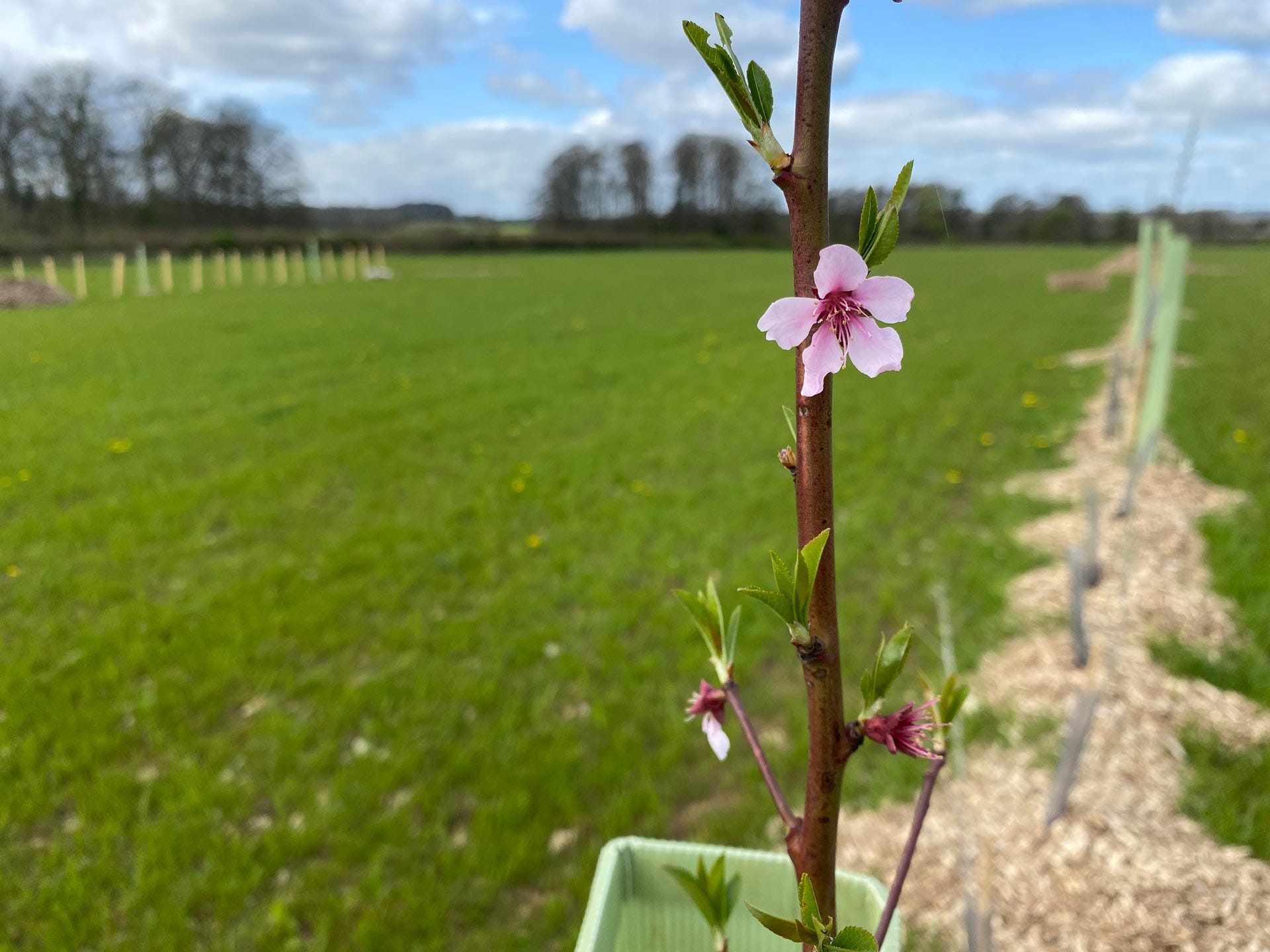
Sapperton Wilder’s agroforestry work was another highlight for me.

Agroforestry brings trees and agricultural production together rather than treating them as completely separate land uses. Walking through the developing system made the concept much more tangible.
You begin to see the farm not simply as fields containing crops or livestock, but as an interconnected landscape.
Trees, soil, livestock, wildlife, water and food production all interact. And because trees take time to establish, agroforestry also forces you to think differently about time.
Some agricultural decisions are about the next harvest.
Others are about what that landscape could look like in ten, twenty or thirty years.
The technology was impressive. But the conversations mattered more.
I came to the residency interested in agricultural innovation. I left thinking much more about how innovation reaches agriculture in the first place. Building Terravore, that distinction matters enormously to me.
I have ideas about vermicomposting, food-waste recycling, in-situ worm systems, soil improvement, and ways to help farms turn organic materials into something valuable.
When you’re passionate about an idea, it's easy to start with the solution.
The residency reinforced why I need to start somewhere else: with the farmer.
- What problem are they trying to solve?
- What already works?
- What doesn’t?
- How much additional work would a new system create?
- Who would actually manage it?
- What happens when something goes wrong?
- Does it save time, reduce costs, improve resilience, produce better information or create another measurable benefit?
And perhaps most importantly:
Would they still want to use it after the trial ends?
For farmers, with farmers
That last question has stayed with me. As Terravore develops our work with farms, I don’t want our approach to be:
“Here’s a vermicomposting system. Let me show you why you need it.”
I want the conversation to begin with:
“Tell me about your farm. What are you trying to improve?”
The difference might seem small, but it changes everything.
It means a trial isn’t simply an opportunity to demonstrate that something works. It becomes an opportunity to discover whether it works here, for this farmer, under these conditions.
And sometimes the answer may be no. That’s useful information too.
Sixteen robots, invisible fences and one very old lesson

When I think back on the residency, plenty of things will stick in my mind.
- A dairy farm of more than 700 cows supported by 16 robots: some feeding the cows, some managing and packing manure, and others milking the cows.
- Cattle grazing inside boundaries they cannot physically see.
- Drones helped reveal how many deer were moving through a farm and how often they arrived to eat the plants.
- Trees being planted today as part of agricultural systems that will continue developing for decades.
- All of that technology is exciting.
But perhaps my biggest lesson from the residency wasn’t technological. It was about listening. If we genuinely want to help agriculture become more circular, regenerative and resilient, farmers cannot simply be the end users of somebody else’s innovation. They need to help create it.
For Terravore, that means spending more time on farms, asking better questions, testing ideas in real-world conditions, and being prepared to change them based on what farmers tell us.
Because sometimes the best innovation doesn’t begin with saying:
“Look what we’ve invented.” It begins with asking: “What do you need?”
Wormly, 🪱
Botanical Barbie for Terravore
Closing the food waste loop, naturally.